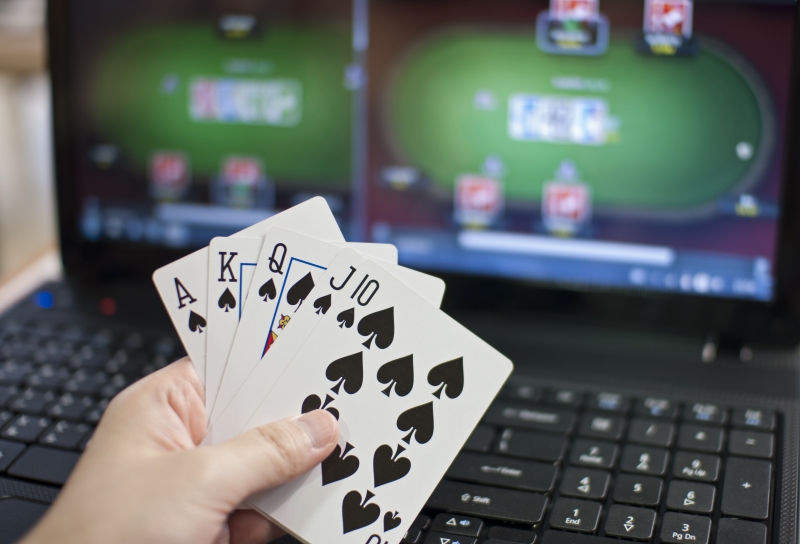
The term online poker simply refers to poker games on the Internet. There are many online poker rooms, all of which offer a wide variety of poker variants and variations in all bet sizes imaginable (including completely free games and tournaments!).
Online Poker vs. Live Poker
Although the rules are basically identical, there are major differences between online and live poker.
Online poker is a lot faster, and you play significantly more hands in the same amount of time than live. The risk is lower, since you can play for very small amounts, and it is much more convenient, since you can access it from anywhere and at any time.
On the other hand, you are playing against "invisibles". The social component of live poker is much higher, as you can play it with friends or even meet new people. Online, this is rather rarely the case. In addition, live poker has a strong psychological component, and you can read a lot from the body language and behavior of your opponents, which is completely absent online. Nevertheless, there are ways and means to recognize so-called tells online as well.
The History of Online Poker
In continental Europe, until a few years ago, poker was mainly associated with smoky backrooms and played mostly in private.
Online, poker was encountered in chat rooms before the year 2000, and there was no money involved at all.
That changed abruptly when Chris Moneymaker qualified for the 2003 WSOP Main Event - the most important live tournament in the world - for around $60 online on PokerStars and ended up taking home the win and a $2.5 million prize.
This fairytale story triggered a poker boom never seen before. Hundreds of thousands, who later became millions, started playing online poker.
Chris Moneymaker's victory suddenly made poker accessible to the masses. The impact of this event was so great that it found its way into the history books. Even today, experts speak of the "Moneymaker effect".
When online poker software was further developed and became much more secure, allowing players to deposit and withdraw money without any problems, there was a further boost. Also, since such players as PayID entered the market, transactions have become even more secure.
A year later, the World Poker Tour revolutionized televised poker by allowing viewers to see players' hole cards for the first time using newly developed cameras. Subsequently, poker became the third most popular TV sport after soccer and Formula One.
All you need to play online poker is an Internet-enabled device (computer, laptop, tablet, smartphone) and the corresponding software of an online poker room.
In the meantime, the major online poker rooms have developed apps for smartphones, so that you can now play online poker on your cell phone from the comfort of your own home.
How Much Money do I Need?
Not too much. At the beginning of your poker career you can play for play money (playmoney) to get a feel for the game and how it works. After that it is recommended to deposit an amount between $50 and $200. This is usually enough to play for a long time if you play at a low level.
One of the most important requirements for long-term success with online poker is conservative bankroll management. This means that you should only play limits that you can afford to play at, and at which you can handle a bad run (downswing) without going broke. If you have deposited $50, then you should play $1 tournaments until you have at least 50-100 buy-ins of the next higher limit.
If the next higher limit is $3, for example, you need to earn a bankroll of at least $150, but better $300, before you can advance to that level.
Cash game limits start as low as $0.01/$0.02, which equates to a full 25 buy-ins on a $50 bankroll. With a tight-aggressive play style, the risk of going broke is very low.
How to Play Online Poker?
The first thing you need to do is download the software of an online poker room. This is done quite quickly.
Then you have to install it. During this process, you also create your personal poker account.
To play online poker you must be at least 18 years old. The age is checked. This age check is easy to bypass, but at the latest when you try to withdraw a larger amount from your poker account, , so you should be prepared not to be able to play if you are younger.
A credit or debit card is usually required to make a deposit. All providers accept Visa, Mastercard or PayID.
What Poker Variants are Offered?
There are many different poker variants, but only about a handful are actively played online. By far the most popular variant is No-Limit Holdem, which poker legend Doyle Brunson once called "The Cadillac of Poker".
In No-Limit Hold'em, you are dealt two cards and must combine them with up to five community cards to form the best possible five-card poker hand. A popular saying goes, "It only takes a few minutes to learn the game, but a lifetime to master it."
Online Poker Tournaments
In a poker tournament, you get a certain number of chips for your buy-in (entry fee). If you lose all your chips, you're eliminated. Whoever has all the chips in play at the end is the winner of the tournament.
Poker tournaments have gained popularity with the help of major televised tournament series such as the World Series of Poker, the World Poker Tour and the European Poker Tour.
With online tournaments, you have the chance to make a big profit with a small bet. There are some $10 tournaments where the winner gets more than $200,000!
This is because the starting fields in online tournaments are usually much larger than in live tournaments.
The big Sunday tournaments attract thousands of players from all over the world every week. The most famous of these is the Sunday Million on PokerStars, where you can play for a prize pool of one million with a buy-in of $215!
Sit and Gos
Sit and Gos are small poker tournaments that are usually played at just one or a few tables and start as soon as the seats at the tables are filled. Online, due to the large number of players, they run around the clock. In addition, Sit & Gos are not as time-consuming as multi-table tournaments, but the prize pools are much smaller.
How to Find the Best Online Poker Room
Which online poker room suits me best?
The online poker market is highly competitive and there are numerous online poker rooms.
Which provider is the best?
That depends on your own preferences. The biggest providers have the most players, consequently they run the most games and tournaments.
In return, the players at the smaller providers are often much softer, and you get a higher first deposit bonus (more on this below).
Some poker rooms offer several different poker variants (such as PLO, Seven Card Stud, Five Card Stud, 2-7 Triple Draw), while others only offer Hold'em.
So, you should consider where your priorities lie and then choose the appropriate poker room. Our detailed reviews of the best online poker sites will help.
The best poker bonus
Almost all online poker rooms offer a bonus on the first deposit. Usually, this is 100% on the deposit up to a certain amount.
For example, if you deposit $100, you will receive a bonus of up to $100, which only needs to be cleared.
There are a variety of different bonuses - from a free $10 (easy to clear) to a whopping $1000 bonus (difficult to clear).
Before making your first deposit, you should compare the different bonus offers.
Depositing and Withdrawing Money From an Online Poker Room
Depositing and withdrawing money at an online poker room is very easy.
There are many deposit options available such as credit cards, direct and bank transfers, Skrill, or Netteller.
The same is true for withdrawals. The above options are available here as well, plus the good old check.
Secrets of Online Poker
Freerolls are free tournaments where you can play for real money or non-cash prizes without wagering.
There are countless freerolls, and when you sign up for an online poker room through PokerZeit.com, you also get access to other exclusive freerolls.
Basically, freerolls are something like a bonus for the customers of a poker room.
How do You Clear Your Bonus?
There is one thing you need to know. The bonuses that you get from an online poker room must first be cleared before the bonus amount is credited to your account.
In order to release a bonus or a part of it, you have to play a certain number of hands for real money. Moreover, you have only a fixed number of days (usually 30 or 60) to do so.
Therefore, after making your first deposit, you should try to play as much as possible to clear as much of your bonus as possible.
How to Find Your Way Around The Lobby
In the lobby of an online poker room you will find all the cash game tables and tournaments. At first, this can be a bit much and confusing.
In addition, most poker rooms offer a Quick Start option, which is especially helpful for newcomers. You simply enter the variant, limit and number of players, click on "Play Now" and you will be seated at the desired table.
Normally, the lobby is divided into Cash Games, Tournaments and Sit & Goes. Under each of these you will find several tables that can be filtered according to your preferences.
Beginner Tables
Many online poker rooms have beginner tables, which are highly recommended for beginners. Although you can then play only one table, but that does not matter since you are just learning the game. Also, because of this and the slow game speed, good players stay away from these tables.
Record Your Results
You should always record your poker results. Fortunately, there are several tracking software like Pokertracker or Hold'em Manager that do this for you.
After a session you should analyze it with the help of the software. Special attention should be paid to the win rate, the number of flops seen and the Went to Showdown value (WTSD).
In addition, there are numerous online tracking sites that can help one analyze the results.
How can I qualify for live events online?
Many poker players dream of qualifying for a big live tournament online for a few dollars and winning millions, just like Chris Moneymaker did back in the day.
Nowadays it is easier than ever to qualify for a major tournament online as all online poker rooms offer satellites, steps and qualifiers.
Multitabling
One of the main differences between online and live poker is that online you can play multiple tables at the same time.
This allows you to play better than average starting hands, which gives you a big advantage as the hand progresses. Therefore, multitabling, with the right approach, can be very profitable.
Many online pros therefore play more than eight tables at the same time
Loyalty Programs
What many beginners don't know is that for every hand you play for real money, you earn Player Points that can be converted into cash or non-cash prizes.
Player Points are a reward for regular and frequent players. They can be exchanged for cash and attractive merchandise, or used as buy-ins for tournaments.
Therefore, they should be used wisely! When you have collected enough points you can exchange them for great prizes.